
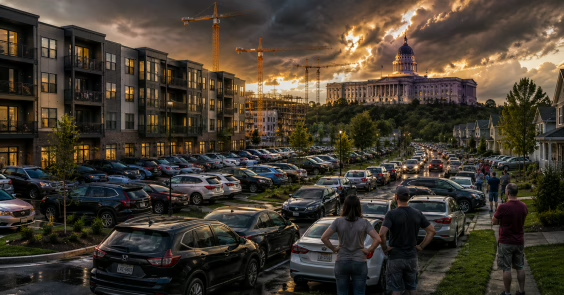
North Carolina has officially entered the era of no parking required.
With Governor Josh Stein signing HB 162 into law, Raleigh has once again decided that local elected officials cannot be trusted to make decisions for their own communities. Instead of allowing cities and towns to determine how much parking is appropriate based on local conditions, the General Assembly has imposed a one-size-fits-all mandate that prohibits local governments from requiring minimum off-street parking for new developments.
Only two house legislators did not vote for this.
Supporters describe the legislation as “parking reform.” They argue that eliminating parking minimums will reduce construction costs, improve housing affordability, reduce stormwater runoff, and create more walkable communities. Those talking points have been repeated almost verbatim by developers, housing advocacy groups, and environmental organizations throughout the legislative process.
But beneath the marketing slogan lies a much simpler reality:
HB 162 transfers another important zoning decision away from local communities and hands greater discretion—and greater profit potential—to developers.
Another Raleigh Power Grab
Every town is different.
A mountain town has different transportation needs than a coastal community. Rural counties have different needs than urban centers. Fast-growing suburbs like Waxhaw bear little resemblance to downtown Raleigh or Durham.
Local elected officials understand these differences because they live with them every day.
State legislators do not.
Yet HB 162 tells every municipality in North Carolina that they are no longer allowed to decide whether new apartments, shopping centers, offices, restaurants, or mixed-use developments should provide any minimum amount of parking.
That decision now belongs almost entirely to the developer.
If the market rewards building fewer parking spaces, fewer parking spaces will be built.
And if nearby neighborhoods become overwhelmed with overflow parking?
That becomes the town’s problem—not the developer’s.
Developer Profits Come First
Parking costs money.
Land costs money.
Every parking space represents property that cannot be converted into another apartment, another townhouse, another commercial tenant, or another source of revenue.
By removing parking requirements statewide, HB 162 gives developers greater flexibility to maximize the economic return on every acre they build.
Supporters frequently cite estimates that structured parking can cost tens of thousands of dollars per space. Those costs are real.
What they rarely mention is where those savings actually go.
Nothing in HB 162 requires developers to pass construction savings on to future homeowners or renters.
Nothing requires lower rents.
Nothing requires lower home prices.
Nothing prevents those savings from simply becoming larger profit margins.
The legislation assumes market forces will deliver affordability.
North Carolinians are simply expected to trust that assumption.
The Affordability Argument Doesn’t Hold Up
Perhaps the weakest justification for HB 162 is the claim that eliminating parking minimums will significantly improve housing affordability.
Housing prices are driven primarily by land values, financing costs, labor shortages, materials, interest rates, insurance, infrastructure, impact fees, and market demand.
Parking is only one piece of a much larger equation.
Even if construction costs decline, there is no mechanism in the law ensuring buyers or renters ever see those savings.
Developers charge what the market will bear—not what construction happened to cost.
In rapidly growing communities, market prices are determined far more by demand than by construction expenses.
Removing parking requirements does not change that basic economic reality.
Someone Still Has to Park
One question rarely answered by supporters is remarkably simple:
Where will everyone park?
North Carolina remains an overwhelmingly automobile-dependent state.
Outside a handful of urban cores, most residents drive to work.
They drive to school.
They drive to restaurants.
They drive to grocery stores.
They drive almost everywhere.
Eliminating minimum parking requirements does not eliminate automobiles.
It simply shifts the consequences elsewhere.
Overflow parking spills into neighborhoods.
Street parking becomes more congested.
Existing public infrastructure absorbs impacts that were previously addressed on private property.
Communities eventually face pressure to build additional public parking—or impose new parking restrictions—using taxpayer dollars.
If Parking Minimums Are Truly Bad, Why Not Let Communities Decide?
Perhaps the most frustrating aspect of HB 162 is that it wasn’t necessary.
If local governments concluded that parking minimums were outdated, they already possessed the authority to reduce or eliminate them.
Many cities had already done exactly that.
Nothing prevented municipalities from modernizing their own ordinances.
HB 162 was never about granting flexibility to local governments.
It was about taking flexibility away.
Instead of allowing communities to balance development with local infrastructure, neighborhood concerns, traffic patterns, and long-term planning goals, Raleigh has declared that every community must follow the same statewide rule.
That isn’t local control.
It’s legislative preemption.
The Pattern Continues
HB 162 is hardly an isolated case.
Over the past several years, the General Assembly has repeatedly limited the authority of local governments over zoning, development standards, and land-use planning.
Each bill is presented as regulatory reform.
Each promises economic benefits.
Each chips away a little more local decision-making.
Whether the subject is parking requirements, zoning authority, design standards, or development approvals, the trend is unmistakable.
The people closest to their communities are increasingly being told their judgment doesn’t matter.
Residents Will Live With the Consequences
Developers build projects.
Communities live with them for decades.
Residents—not developers—deal with crowded streets, neighborhood parking conflicts, infrastructure demands, and changing community character long after construction crews leave town.
Those are precisely the kinds of tradeoffs local elected officials should be empowered to evaluate.
HB 162 says otherwise.
North Carolina may now have no parking required.
Unfortunately, it also has one less example of local self-government.