
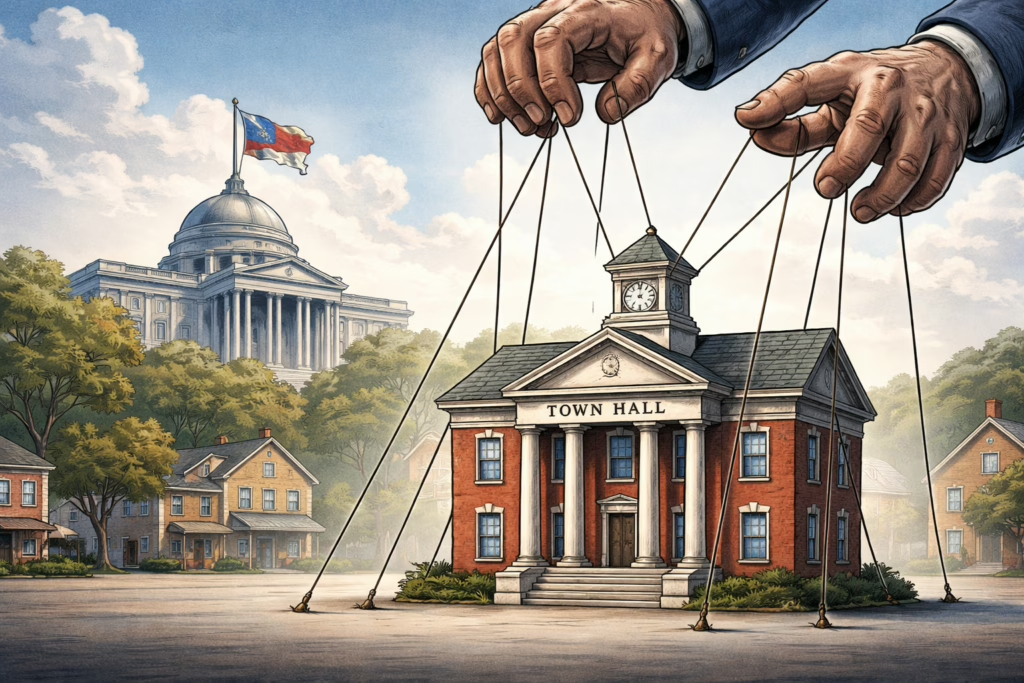
How the NC Home Builders Association Is Neutering Local Representative Government
If you want to understand why local elected officials increasingly feel like middle managers instead of representatives, you don’t need a conspiracy theory. You just need to read the North Carolina Home Builders Association’s own legislative victory list. This is what happens when developers write the rules.
The NCHBA recently circulated a document celebrating its “Top Legislative Accomplishments” from the 2025 session. It’s meant to be a brag sheet. Taken at face value, it is also a roadmap for how concentrated industry power is systematically stripping decision-making authority away from towns, counties, and the people who elect them.
This isn’t about one bill. It’s about a philosophy: if local governments don’t do what developers want, the rules should be rewritten so they don’t get a choice.
From Local Judgment to State Mandate
Again and again, the NCHBA celebrates legislation that does one thing very well: it replaces local judgment with state-imposed uniformity.
Local street standards? Capped at NCDOT minimums—even for private roads municipalities will eventually inherit and maintain.
Zoning timelines? Forced approvals if elected boards don’t move fast enough, regardless of complexity or public concern.
Density decisions? Shifted from community-specific planning to state-defined formulas.
Inspection practices? Micromanaged by statute, down to whether a local department can charge a cancellation fee.
Each of these changes is sold as “regulatory certainty” or “efficiency.” In reality, they all share a common feature: they remove discretion from locally elected bodies and professional staff who actually understand local conditions.
Uniformity sounds fair until you realize it assumes that a mountain town, a coastal community, and a fast-growing suburb should all be governed exactly the same way.
Automatic Approval: The End of Deliberation
One of the most troubling patterns is the push for automatic approval provisions.
Several bills celebrated by NCHBA require local governments to approve development applications within rigid timelines—or else the project is approved by default.
Think about what that means.
If a developer submits a massive rezoning or subdivision proposal, and staff are understaffed, or inter-agency comments arrive late, or public input raises legitimate issues, the penalty is not a delay. The penalty is losing the right to decide at all.
This turns representative government into a stopwatch exercise. It punishes caution, rewards volume filers, and incentivizes rubber-stamping over thoughtful review.
That’s not reform. That’s coercion.
Dillon Rule as a Weapon, Not a Principle
North Carolina has long operated under the Dillon Rule, which says local governments only have powers granted by the state. Historically, that principle came with flexibility and trust.
The new wave of legislation weaponizes the Dillon Rule instead.
Bills like HB 765 and SB 205 don’t just clarify authority—they aggressively narrow it, invite litigation, and create private rights of action with attorney’s fees attached. The message to local governments is unmistakable: resist, and you’ll be sued.
When associations can enforce development law through civil action, while elected boards are boxed in by statutory mandates, accountability shifts away from voters and toward courts and lobbyists.
Disaster Relief as a Trojan Horse
Some of the most sweeping preemptions are tucked into disaster relief and budget bills.
Under the banner of hurricane recovery, local tree ordinances are suspended. Permit expirations are extended. Nonconforming structures are allowed to be rebuilt with limited local input.
Emergency flexibility is important—but when these provisions are extended broadly and indefinitely, they become policy shortcuts. Disaster becomes the excuse to bypass local control even in communities untouched by the event.
Temporary relief quietly becomes permanent erosion.
Who Benefits—and Who Pays?
The NCHBA is refreshingly honest about who benefits from these laws: “our members.”
What’s less discussed is who pays the long-term costs.
• Residents who inherit underbuilt roads
• Taxpayers who maintain infrastructure built to minimum standards
• Communities forced into growth patterns they didn’t choose
• Elected officials blamed for outcomes they no longer control
When a town can’t require better streets, can’t pace rezonings, can’t enforce meaningful conditions, and can’t even delay a bad proposal without risking automatic approval—what exactly are local elections for?
This Is Not About Housing. It’s About Power.
Housing affordability is a real issue. But affordability does not require stripping communities of their voice.
Nothing in these bills requires builders to construct smaller homes, more starter housing, or workforce units. What they do require is faster approvals, fewer conditions, and less local resistance.
That’s not housing policy. That’s leverage.
The most revealing line in the NCHBA document isn’t about homes at all—it’s the repeated celebration of limiting “unlawful local requirements.” Translated: local governments shouldn’t be allowed to say no, slow down, or ask for more than the bare minimum.
That’s not conservative governance. It’s centralized control—just with a different beneficiary.
Read the Brag Sheet Carefully
The NCHBA didn’t hide its goals. They published them.
If you care about representative government, and communities shaping their own future, you should read these legislative “accomplishments” closely.
Because what’s being dismantled here isn’t red tape.
It’s the idea that local voters, through their elected officials, have the right to decide what their town becomes.